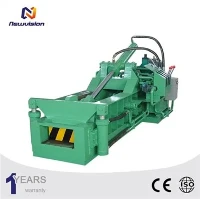

If you’ve spent any time working in the scrap metal recycling industry, you know that profit margins are often razor-thin. Every dollar saved on labor, energy, and material handling, and every extra pound of recyclable material you can process and sell makes a huge difference to your bottom line. A question I hear from customers all the time is: Can a PLC-controlled scrap metal baler really make that big of an impact? As someone who’s been in the business of providing PLC-controlled scrap metal balers for over a decade, I’m here to break down exactly how this technology turns efficiency gains into tangible profit for recycling operations—no hype, just real results.
First, let’s ground this in what a PLC-controlled baler actually does. PLC stands for Programmable Logic Controller, a computer system designed specifically for industrial automation that can take input from sensors, execute pre-programmed tasks, and adjust operations in real time. For a scrap metal baler, that means moving away from manual, labor-intensive operations to a fully automated, precision-controlled process. A few years back, I worked with a mid-sized recycling yard in Ohio that was running a mix of manual and semi-automatic balers. They were spending 12 hours a day just on feeding material, adjusting pressure manually, and tying bales by hand. After switching to a Scrap Metal Baler with PLC control, their daily processing time dropped to 7 hours. That’s 5 extra hours a day they could use to process more material, or reassign workers to higher-value tasks like sorting rare metals instead of tying wire.


One of the biggest profit drivers here is labor cost. The recycling industry is notorious for high turnover in operational roles, and manual baling requires physically demanding work that’s hard to fill and even harder to retain. A 2022 report from the Institute of Scrap Recycling Industries (ISRI) found that labor costs make up roughly 20-25% of a typical yard’s operating expenses. With PLC control, you cut that cost drastically. The system can run continuously with minimal supervision—one operator can manage multiple balers at once, instead of needing two or three per machine. The Ohio yard I mentioned earlier went from 6 full-time operators for their three balers to 2, saving them over $180,000 a year in wages and benefits. That’s pure profit, right off the top.
Next, let’s talk about material consistency and bale density—two factors that directly affect how much you get paid per ton. Scrap metal buyers pay premium rates for dense, uniform bales because they’re easier to transport, take up less space in shipping containers, and melt more efficiently at steel mills. Manual balers often produce inconsistent bales: some are too loose, so they shift during transit and get rejected, or too dense in spots, causing wear and tear on the baler. PLC-controlled balers use pressure sensors to adjust force automatically based on the material type. For example, thin aluminum cans need a different pressure setting than thick steel beams. The PLC can pre-load these settings, so if you switch from processing aluminum to copper, it adjusts without manual tweaks. A customer in Texas that specializes in aluminum can recycling told me that after switching to our Competitive Prices Aluminum Can Recycling Machinery Imported Baling Press, their bale density went up by 18%, and their average payment per ton increased by 12% because none of their bales were rejected for being improperly compacted. That’s not a small gain—for a yard processing 500 tons of aluminum a month, that’s an extra $15,000 in revenue every month.
Energy efficiency is another area where PLC-controlled balers deliver real savings. Older balers run on fixed power settings, often wasting energy by over-pressuring light materials or under-pressuring heavy ones. The PLC system monitors real-time material load and adjusts hydraulic pressure and motor speed to match exactly what’s needed. That cuts energy use by up to 30%, according to tests we’ve run with independent industrial engineering firms. A Pennsylvania recycling yard that processes a mix of copper, iron, and sheet metal saw their monthly electricity bill drop from $4,200 to $2,800 after switching to a Copper Iron Sheet Metal Baler Automatic Scrap Metal Press Recycling with PLC control. Over a year, that’s $16,800 back in their pocket. For yards operating on tight margins, those energy savings can be the difference between breaking even and turning a profit.
One often-overlooked benefit is reduced equipment wear and downtime. Manual balers rely on human operators to stop the machine if something goes wrong, which means small issues (like a misaligned piece of metal that gets jammed) can turn into major breakdowns. PLC systems have built-in fault detection sensors that alert operators to issues before they cause damage, and they can automatically shut down the machine to prevent overloading or mechanical stress. A 2021 study by the National Association of Metal Recyclers found that automated balers with PLC control experience 40% less downtime than manual models, because small issues are caught and fixed quickly. Less downtime means more hours of operation, and every hour a baler is down is an hour you’re not processing material. For a yard that runs two shifts a day, that’s an extra 1,600 hours of processing time a year—enough to process an additional 1,200 tons of scrap metal, at an average margin of $35 per ton, that’s $42,000 in extra profit.
Let’s not forget about versatility. Many recycling yards process more than just one type of material—aluminum cans, steel, copper wire, even scrap tires. Trying to handle multiple materials with different balers is expensive in terms of space and equipment costs. PLC-controlled balers can be programmed to handle a wide range of materials, with quick setting changes that take 2-3 minutes instead of the 20-30 minutes needed for manual adjustments. For yards that process tire wire, we’ve found that our Scrap Tire Wire Baler Machine with PLC control can produce high-density bales that meet steel mill specs, turning a material that many yards have to dispose of into a high-value product. A customer in Georgia was previously paying $12 per ton to have tire wire hauled away; now they process 20 tons a month, selling it for $180 per ton— that’s $3,360 in monthly profit from a material that was once a cost.
Now, I know some operators are hesitant to invest in new technology, especially with upfront costs. It’s true that a PLC-controlled baler has a higher initial price than a manual model, but the ROI is much faster than most people expect. Let’s do the math for a typical mid-sized yard: assuming you process 10,000 tons of scrap metal a year, with average gains of $15 per ton from labor savings, $8 per ton from higher bale value, $5 per ton from energy savings, and $7 per ton from reduced downtime, that’s $35 per ton in total extra profit. Over a year, that’s $350,000 in additional revenue. Even after accounting for the cost of the machine and installation, most customers see a full return on their investment in 12-18 months. That’s a no-brainer for any business looking to grow.
Of course, PLC-controlled balers aren’t a one-size-fits-all solution. You need to match the machine to your specific operation—whether you’re a small yard focusing on aluminum cans, a large facility processing mixed scrap, or a specialty yard handling tire wire or copper. That’s why taking the time to assess your current workflow, identify bottlenecks, and work with a supplier that can customize the machine to your needs is critical. As someone who’s spent years working with recycling businesses, I always tell customers that the best investment isn’t just the machine—it’s the partnership with a supplier who understands your industry, can provide training for your operators, and offers ongoing support to keep your baler running smoothly.
If you’re ready to take the next step to improve your recycling business’s profit margin, we’re here to help. Our team has worked with hundreds of recycling yards across the country to find the right PLC-controlled baler for their specific needs, and we’re ready to walk you through the options, answer your questions, and help you calculate the exact ROI for your operation. Whether you’re looking for a machine to process aluminum cans, scrap metal, tire wire, or any other recyclable material, we can provide a solution that fits your budget and your goals. Don’t let slim margins hold your business back—invest in technology that turns efficiency into profit, and start seeing results in as little as a year.
References:
Institute of Scrap Recycling Industries. (2022). 2022 Scrap Recycling Industry Cost & Profit Analysis. Washington, D.C.
National Association of Metal Recyclers. (2021). Automated Equipment Performance in Scrap Operations. Chicago, IL.
Industrial Energy Management Association. (2020). Energy Efficiency in Industrial Material Handling Equipment. Washington, D.C.